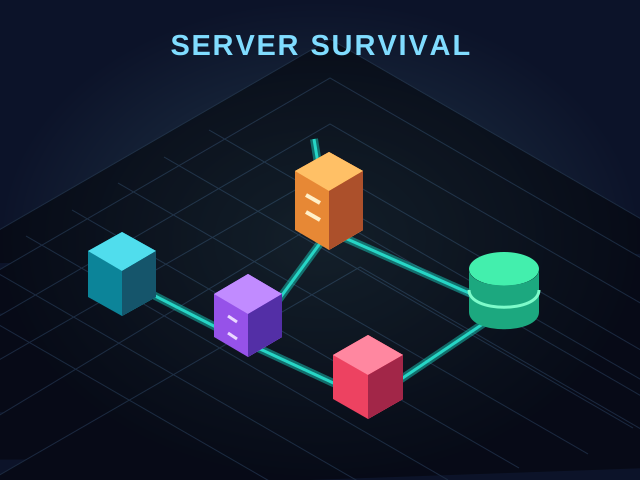
Server Survival
Management games
Best on desktopManagement games ask you to balance several related decisions. A useful approach is to observe the system, identify a bottleneck and change one part at a time.
The available game summaries below describe what you actually manage. In Server Survival, placing a service is only one step: its connection to the traffic path matters too. Virtual cloud services are game objects, not paid resources in a real account.
Build a virtual cloud and keep it running as traffic grows. Try survival, campaign or sandbox mode in this browser simulation; no real server is needed.
Choose a game mode. Select services from the toolbar, click to place them, and connect the network. Drag with the right mouse button to pan and scroll to zoom. Music is omitted; synthetic game tones remain. Internet → Firewall → Load Balancer → Compute → Database / Storage.
Simulation games let you explore how a fictional system behaves. Check whether the game has a campaign objective, a survival challenge or a sandbox before choosing a strategy.
Server Survival asks you to arrange a virtual cloud network and keep it working as traffic grows. The services in its scene are game objects, not infrastructure that creates a paid provider account or runs a real workload for you. Read the available modes and choose whether you want the game to present a campaign, a survival challenge or a sandbox. A management game can look like a building scene, but the connections and changing conditions give your placement a different purpose. If you want to create a scene without this network-management goal, compare the building category. Use the actual Server Survival description and controls rather than assuming that strategies from an unrelated business or city management game apply to this edition.
The service must fit a connected route, so inspect where traffic can go before adding another object. The published control summary describes the path from Internet through Firewall and Load Balancer to Compute and Database or Storage. Use that summary as an introduction to the game's model, then observe what the current scene shows. A placed object that is disconnected or on an unsuitable route can behave differently from the same object in a working connection. Change one connection and compare the visible effect instead of rebuilding the whole network without a diagnosis. The management game guide offers a small experiment and review prompts for this process. It does not configure a real server or guarantee that a larger network automatically performs better in the game.
Keep the mode and the decision you are testing clear. A sandbox experiment and a survival attempt can ask different questions, so their outcomes are not directly interchangeable. Note which service or connection you changed, what the network did before that change and what happened afterward. If a traffic increase exposed a problem, look for where the visible route or capacity became limiting before adding unrelated services. Avoid changing every part of the scene in one attempt: that makes it difficult to connect an outcome with a decision. Check the edition's device support and controls when placement or navigation is the issue. Saving a favorite on Cozcade gives you a return link; it does not create a backup of the virtual network state inside Server Survival.